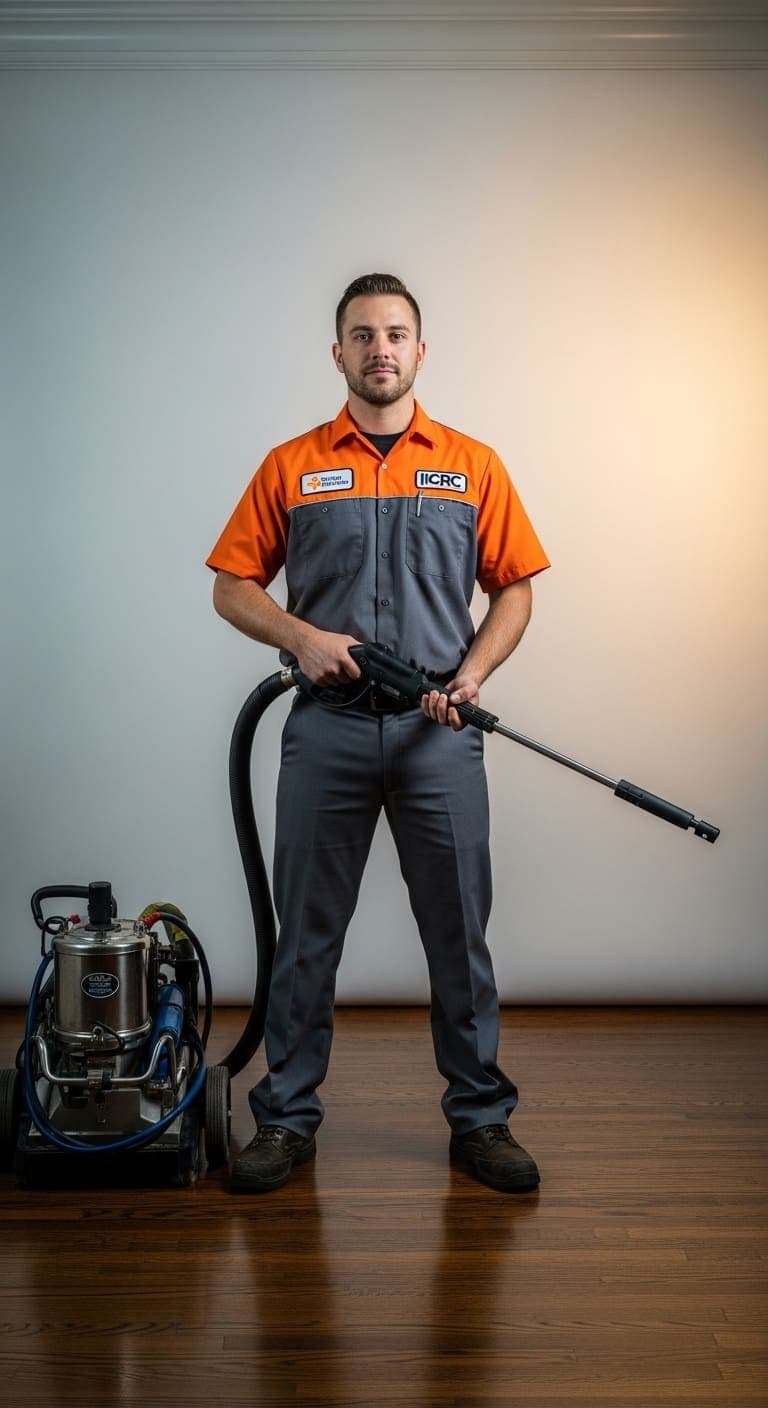
If you have ever looked up water damage restoration or mold remediation companies in Northern Virginia, you have probably seen the IICRC logo on a lot of websites. Not all of them have earned it. And among those that have, the certification is maintained at different levels of rigor.
Understanding what the certification actually means helps you ask better questions when evaluating a restoration company.
What IICRC is
The Institute of Inspection, Cleaning and Restoration Certification (IICRC) is an international standard-setting body for the cleaning and restoration industry. It develops technical standards — currently more than thirty of them — covering everything from water damage mitigation to mold remediation to upholstery cleaning.
The S500 standard governs professional water damage restoration. The S520 governs mold remediation. These documents define how work should be scoped, performed, and documented. They are not marketing materials. They are technical specifications.
What certification means in practice
An IICRC-certified firm has met specific criteria: technicians who hold current individual certifications, continuing education requirements, and agreement to the organization's code of ethics. The certifications are not permanent — they require renewal and ongoing training.
Technician-level certifications (like WRT for Water Damage Restoration Technician or AMRT for Applied Microbial Remediation Technician) require passing an exam that covers the relevant technical standard. A technician who holds a WRT has demonstrated knowledge of moisture behavior, psychrometrics, materials science as it relates to water damage, and the procedural requirements of the S500.
This matters because restoration work involves real technical decisions. When does drywall need to come out versus be dried in place? What moisture readings confirm that structural materials are adequately dry before enclosure? How is containment set up to prevent cross-contamination during mold remediation? These are not judgment calls that should be made by guessing.
What it does not mean
Certification is a floor, not a ceiling. Having certified technicians means a company meets baseline competency requirements. It does not automatically mean they are the best option for your situation or that they operate at the highest possible standard.
It also does not mean that every person on a crew is certified. Some firms have one or two certified technicians and a larger crew of uncertified workers. If this matters to you, ask specifically whether the technicians who will be on-site for your job hold current IICRC certifications.
Documentation and the standard of care
One of the things IICRC standards emphasize is documentation. The S500 requires that moisture readings be taken and recorded throughout the dry-out process. This documentation serves multiple purposes: it tells the technician what is actually happening in the structure, it creates a record for insurance purposes, and it provides evidence that the work was performed to standard.
When you receive a claim from a restoration company, you should be able to get a moisture log — readings taken over the course of the dry-out showing the progression of drying across affected materials. If a company cannot provide this, or did not take systematic readings, that is worth knowing.
The insurance dimension
Insurance adjusters are familiar with IICRC standards. When a claim is filed, the adjuster will often evaluate whether the work was performed in accordance with those standards. If a restoration company cut corners — removed less material than necessary, did not document readings, or closed up a wet space — that can become a problem for the homeowner when the insurer reviews the claim.
Working with a certified firm that documents its work properly is not just about quality. It protects your claim.
Asking the right questions
When evaluating a restoration company, reasonable questions include: Are your technicians IICRC-certified, and for which certifications? Will the technicians on-site for my job be certified? Do you follow the S500 (or S520 for mold) and can you provide documentation of moisture readings? Do you work with a public adjuster or have relationships with independent labs for post-remediation testing?
A competent company will answer these directly. Vague responses or redirecting to marketing language is useful information in itself.
The restoration industry, like any service industry, has a range of operators. Certification, documentation practices, and transparency about process are reasonable proxies for the quality of work you can expect.